Best Espresso Machines for Lattes in 2026
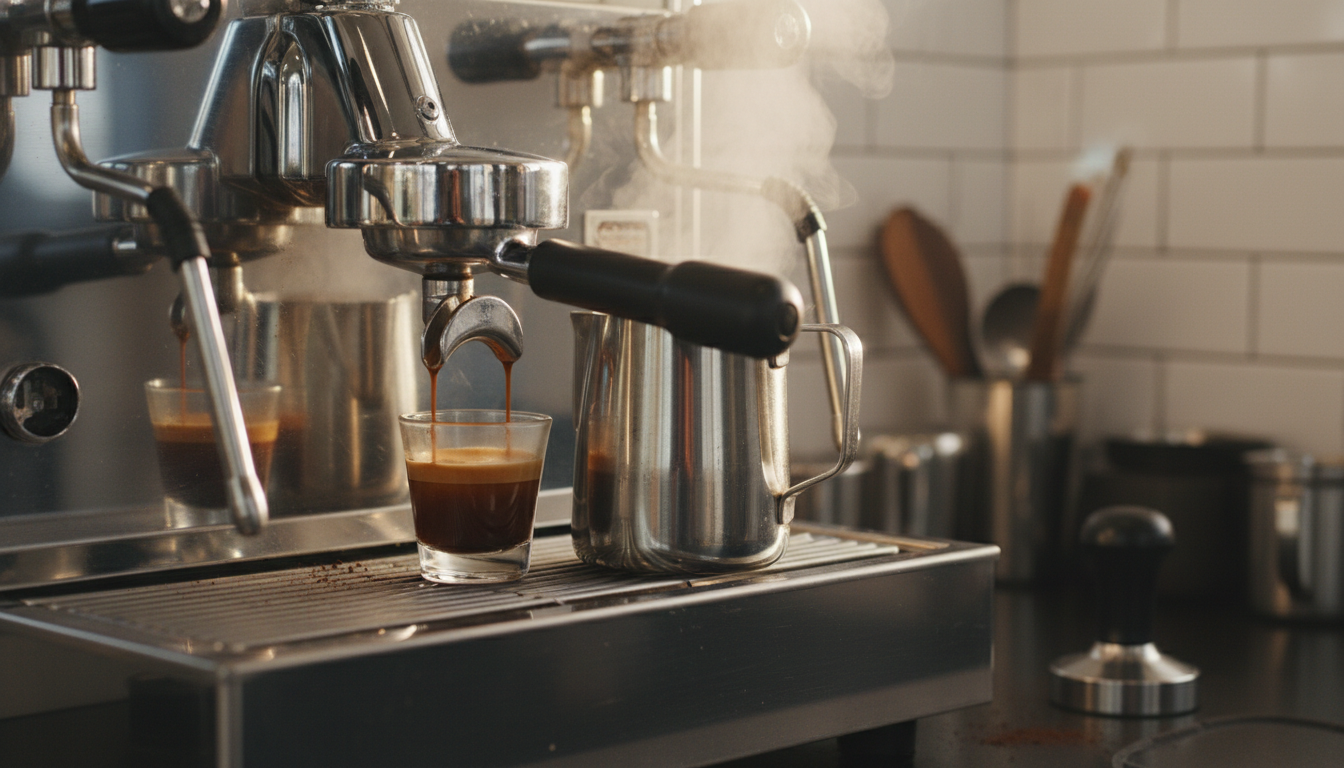
Pulling a good latte at home requires two things: a machine that produces enough pressure and temperature stability to extract a proper shot, and a steam wand with enough power to texture milk. Most budget machines fail on one or both counts. Here are the picks worth spending money on, ranked by what kind of home barista you are.
What Makes a Machine Latte-Ready
Espresso for lattes needs to be concentrated and balanced — under-extracted espresso turns a 6 oz latte bitter and thin. That means you want a machine with a stable 9-bar pump and a thermoblock or boiler that recovers quickly between shots.
The steam wand matters just as much. Panarello-style wands (the ones with a plastic sleeve) produce froth, not microfoam. For latte art or a properly silky texture, you need a bare steam tip with at least two holes and a boiler that can sustain pressure for 45–60 seconds without dropping off.
Single-boiler machines make you wait between brewing and steaming. Heat exchangers and dual boilers let you do both simultaneously. For high-volume latte pulling — two or more drinks in a row — the wait time on a single boiler adds up fast.
Best Entry-Level Pick: Breville Bambino Plus
The Bambino Plus sits around $500 and punches well above its price. It has a thermojet heating system that reaches brew temperature in three seconds and an automatic steam wand that textures milk to around 60°C by default — adjustable if you want to go manual.
It’s a single boiler, but the fast heat-up nearly eliminates the wait. The portafilter is 54mm and compatible with a wide range of aftermarket baskets. For someone making one or two lattes a day without wanting to dial in water temperature or pressure profiles, this is the machine.
The main limitation: the auto-steam wand can produce milk that’s slightly too airy for precise latte art. If that matters to you, switch to manual mode after a few sessions.
Best Mid-Range Pick: Rancilio Silvia Pro X
At roughly $1,700, the Silvia Pro X is a dual-boiler machine in a compact footprint. You can brew and steam at the same time, the PID controllers on both boilers are accurate, and the commercial-style 58mm portafilter means you have access to every aftermarket basket, tamper, and puck screen on the market.
It has no pressure profiling and no shot timer built in — those are deliberate omissions that keep the machine simple and reliable. Add a decent scale (Acaia Lunar or Timemore Black Mirror Basic Pro) and you have a complete setup that will make better lattes than most café equipment.
The Silvia Pro X rewards grinder investment. Pair it with at least an Eureka Mignon Specialita or Baratza Sette 270 — anything less and you’re bottlenecking the machine.
Best Prosumer Pick: Lelit Bianca V3
The Bianca V3 (around $2,800) is the machine to buy if you want pressure profiling without moving into full commercial territory. Its paddle valve lets you manually control pre-infusion and flow rate mid-shot, which has a noticeable effect on latte flavor when you’re pulling light roasts that need a softer ramp-up.
It’s a dual-boiler, E61 group head machine with excellent thermal stability. The E61 group adds thermal mass, which means more consistency across back-to-back shots — relevant when you’re making lattes for multiple people.
The learning curve is real. Plan on two to three weeks of dialing in before you’re pulling shots you’d serve to a guest.
Best Super-Automatic: De’Longhi Dinamica Plus
If grinding, tamping, and steaming separately sounds like work rather than a hobby, the Dinamica Plus (around $800–900) handles it all in one unit. Beans go in, latte comes out. The milk carafe system produces decent foam — not microfoam, but acceptable for everyday drinks.
The trade-off is control. You can adjust strength and temperature, but you can’t change grind size with the precision of a standalone grinder, and the espresso flavor ceiling is lower than any of the machines above. For a household where multiple people want lattes quickly with no technique required, it’s a reasonable answer.
Grinder: The Part People Underbudget
No espresso machine makes good lattes with pre-ground coffee or a blade grinder. A burr grinder with stepless or fine-stepped adjustment is non-negotiable.
Minimum viable options:
- Baratza Sette 270 (~$380) — fast, consistent, good for medium-dark roasts
- Eureka Mignon Specialita (~$500) — quieter, better for light roasts, excellent retention
- Niche Zero (~$700) — single-dose, near-zero retention, works with any roast level
Budget at least 40–50% of your machine spend on a grinder. The Bambino Plus with a Specialita outperforms a Silvia Pro X with a $100 grinder every time.
Decision Criteria at a Glance
- One or two lattes a day, new to espresso → Breville Bambino Plus + Eureka Mignon Specialita
- Serious home barista, want longevity and repairability → Rancilio Silvia Pro X + Niche Zero
- Want pressure profiling and top-tier results → Lelit Bianca V3 + matching grinder budget
- No technique, just want a latte button → De’Longhi Dinamica Plus
Bottom line: The Breville Bambino Plus is the right starting point for most people. If you already know you’re committed to the craft, skip it and buy the Silvia Pro X — you’ll reach its ceiling much later, and the 58mm ecosystem gives you room to grow.